Data collection in today’s online world is raising ethical questions at every turn. As technology becomes more and more advanced, our world seems to get smaller and smaller. Because of this fact, companies are now able to find exactly where I am at any given time in the day. This type of information used to cost our government billions of dollars and a round the clock surveillance team. Now, the average 20-year-old computer geek can create an app that tracks your location throughout the day. There are two main culprits of this new phenomena: Facebook and smartphones. Facebook holds information for more than one billion people throughout the world. Facebook has data on people’s age, sex, religious and political views, and even the daily rants people post as their statuses. The other major contributor to easy accessible personal information is smartphones. Smartphones allow companies to track the exact location of users. Location and personal information like religious views are very valuable information to advertisers. Facebook and Google are able to make billions of dollars by selling this personal information to the highest bidders. The question is where to draw the line?
 |
| "Girls Around Me" App" Taking stalking too far |
I
will first discuss this ethical issue as it pertains to Facebook. Facebook is
the most used social media platform in the world. In the Wall Street Journal
article “Selling You on Facebook”, Julia Angwin made the public aware about the
information vultures known as apps. Applications on Facebook are third party
software that Facebook allows users to download. There are thousands upon
thousands of apps out there with very little regulation. These apps are often
another form of social media where consumers post personal information to
interact with their friends. The app companies make their money from selling
this personal information to advertising companies who are now better able to
target their consumers. One of the most morally suspect apps out there was an
app called “Girls around Me”. The app linked with FourSquare to notify guys of
girls in their area. Strangers could pull up a girl’s profile and find out
which bar she was at. This type of information should not be accessible to
strangers. Because this app broke a clear social norm, Facebook shut it down.
However, apps like these are all over Facebook.
Apps
often ask for information about a user’s friends. I could download an app and
type in personal information about all my friends without any of them being
notified. This is the biggest problem with the applications. Third parties
should not be allowed access to personal information without the consent of
that person. The privacy settings of Facebook profiles hide information like
birthdays and religious views from the general public, but there is not a
mechanism in place to stop friends from sharing information about each other.
Facebook needs to tighten its security requirements for these applications. The
public cannot be held responsible for understanding every “terms and
conditions” waiver. Facebook needs to create a strict code that protects the
interests of their users from apps attempting to sell personal information to
advertisers. Facebook needs to make their users aware when companies are trying
to take personal information off user’s profiles.
Smartphones
are another area that must solve the ethical dilemma of data collection. The
main concern the Wall Street Journal addresses with Smartphones is their
ability to track customers locations. In “Apple, Google collect User Data”
Julia Angwin compares two of the largest smartphone providers. Both of these
companies have location services on their smartphones. These location services
are primarily used for applications like maps. They allow users to pinpoint
their location and get directions. For tasks like these, geographically
challenged users like me are eternally grateful for the location service. But,
the dilemma that needs to be addressed is
“who is able to see my location information?”.
After
extensive research, the Wall Street Journal found that our location information
is far less secure than we thought. Researchers found that phones actually
store unencrypted location information about an individual stretching back a
few months. This would allow a moderately skilled hacker to find out the
patterns of a specific individual. They would know what gym you frequent, where
you get your haircut, and most importantly, your home address! The biggest
issue with location trackers is that the information stored can be linked back
to an individual person. These files are stored by default and very few users
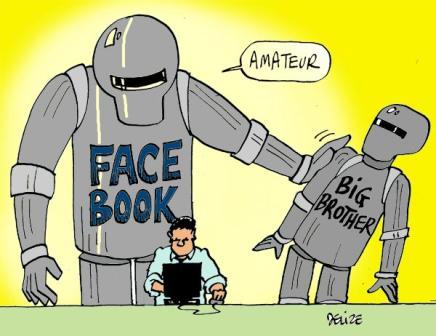
are aware that they are being tracked everyday. The idea that “big brother is
watching” cannot be more true than it is today. The Patriot Act caused uproar
in America when the public was made aware that the government had the ability
to invade the private lives of their citizens. It is a much scarier thought to
know that corporations have just as much power (or even more) and that these
corporations are not securing this information.

Between
Facebook and smartphones, something must be done to stop the ease of access to
presumably private information. The government has not been able to make laws
that keep up with technology. A mixture of pubic awareness and public policy is
the only way Americans can be protected from hackers taking their private
information. The public must do a better job about being aware of what
information they are putting online. The public needs to understand that ones
personal safety is more important than the world knowing which bar you decided
to go to on a Thursday night.
The
government’s role in fixing this dilemma is to place stricter rules on major
corporations like Facebook, Apple, and Google. The government cannot afford to
be two steps behind technology. They must hold these corporations accountable
for the actions of third party programmers on their servers. Facebook needs a
screening process that prevents applications from taking more information than
is reasonably necessary. Facebook must also monitor whom the third party
applications are selling user’s information to. The government has to treat the
sale of private information the same as they would treat a criminal robbing a
home. Programmers are essentially stealing private information for profit. They
are endangering the American people for the sake of monetary gain.
 |
| Ed Markey and Joe Barton, Congressmen fighting for privacy |
The
government must also crack down on the poor security of smartphone companies.
The data collection must change in way that prevents a company from knowing the
start and end location of a specific user. Companies should not be able to be
able to track a phone to a person’s name. Mapping features and location
services are not bad for society. When these location services start acting as
tracking devices for specific people, people’s lives become endangered. The
government will need to force companies to secure location information. Third
party applications will need to spend the capital on securing location
information for their users too. The government might need to make an example
out of some of these large corporations to make sure they understand the
severity of this situation.
After
reading these two articles about data collection, I am now tempted to delete my
Facebook and start using landlines. I fall into the category of the ignorant
consumer who places too much trust into companies like Apple and Google. I need
to understand that my personal information is now floating around the web for a
hacker to find at any time. I hope that profits for advertising companies do
not outweigh the security risk that technology now places the American people
in. It is sad to acknowledge the fact that billions of dollars can make CEO’s
blur the lines of safety and security.

Hi Luke,
ReplyDeleteFantastic job!! This was your best blog yet and I appreciate the level of detail you provided not only in the discussion of the issues but also in the solution. Keep up the good work!
Best,
Jessica