Sunday, December 2, 2012

Blog 6 Reflection


The first concept that comes to mind that was enriched by the project is the concept of a customer persona. In class, we talked about how to segment customers and gather a better understanding of whom we are selling our product to. In this discussion, we talked about going beyond basic demographics to understand the customer. Professor Walls discussed how a persona should cover the seemingly trivial aspects of a person’s life. The purpose of creating an in-depth persona is to be able to create a tailored product for this persona. In our project, we did this very exercise to understand the persona of a post-grad female. We had to break down our persona’s daily schedule. We had to understand where she worked and where she played. Beyond her actions, our group had to understand what drove her to these actions. We had to use the empathy map for a person we did not even know. Spending hours trying to create a person helped us understand the “why” behind many human actions that we could never of thought of without this exercise. Understanding the persona created a firm foundation for our group to explore the actual needs of our target market. I never realized that starting specific as opposed to broad would prove to be more beneficial in understanding a consumer market. There are so many facets to a person’s decision-making process that one cannot account for based off simple demographics. I can rationally assume that a post-grad in Austin is more likely to look at Twitter, but without a persona, I am not able to know why he/she is using Twitter.

Another concept from lecture that the project furthered my understanding of is data visualization. Data visualization is the process of placing data into easily viewable charts or graphs so the audience can gain a better grasp of the results of research. Professor Walls walked us through various ways to display data on PowerPoint. He was able to give us examples of creative ways to show data to an audience. Words on a slide and simple charts were made out to be unacceptable. This project gave me an opportunity to experiment with data visualization. As a Finance major, I have not been asked to be creative when it comes to displaying research results. During this project, my group was kind enough to critique my trial attempts at creating visually appealing slides. This project produced many different types of data that were difficult to display. This project forced me to find new ways of exhibiting data in a way that added to the audience’s understanding of the data. Here is an example of one of the slides I applied the visualization concept to: 

The concept from lecture that served to be least helpful in the project has to be the lecture on ethics. The lecture on Ethics and Privacy helped us understand the various ethical dilemmas that marketers are faced with daily. The articles about Facebook and Google opened my eyes to the harsh reality of customer’s lack of privacy. Private information about customers is so readily available that companies can know pretty much everything about someone from their social media page. This information is also very valuable to marketers when they want to segment customers into very specific categories. This lecture created a beneficial dialogue among the students about where the line should be drawn for companies. Unfortunately, the project did not allow for our group to apply these concepts. There was not a requirement for our group to discuss our prototype from a moral perspective. I feel like we could have explored this side of the prototype more especially as we plan to link our prototype to Facebook and other social medias.

Personally, my interaction with other group members throughout the semester was one of the most rewarding aspects of this entire project. We all come from very different backgrounds. We clearly have different interests and different approaches to work. These different backgrounds and different styles helped my group avoid homogenous ideas. It helped us conjure up a wide variety of suggestions for our persona and our research methodology. My group helped me better understand concepts from class. For example, Savita grasped the research methodology lecture significantly better than me and was able to explain research approaches to me in a practical manner. The consistent feedback from both Professor Walls and Jessica also helped the overall experience of the class. We were able to stay on track and it was easy to ask questions to both instructors. Jessica was patient with my incessant questions about the project and my need to know the reason “why” for every step of this project. Without in-depth feedback, I believe our project would have suffered and ultimately been a failure. My group definitely helped me grasp difficult concepts throughout the semester and I am grateful for their ability to put up with me for a few months.


Monday, November 12, 2012

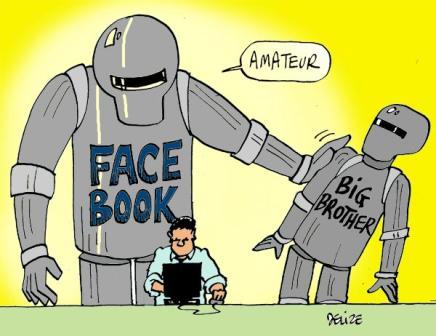
Big Brother Is Watching (Blog 5)


       Data collection in today’s online world is raising ethical questions at every turn. As technology becomes more and more advanced, our world seems to get smaller and smaller. Because of this fact, companies are now able to find exactly where I am at any given time in the day. This type of information used to cost our government billions of dollars and a round the clock surveillance team. Now, the average 20-year-old computer geek can create an app that tracks your location throughout the day.  There are two main culprits of this new phenomena: Facebook and smartphones. Facebook holds information for more than one billion people throughout the world. Facebook has data on people’s age, sex, religious and political views, and even the daily rants people post as their statuses. The other major contributor to easy accessible personal information is smartphones. Smartphones allow companies to track the exact location of users. Location and personal information like religious views are very valuable information to advertisers. Facebook and Google are able to make billions of dollars by selling this personal information to the highest bidders. The question is where to draw the line?
"Girls Around Me" App" Taking stalking too far


I will first discuss this ethical issue as it pertains to Facebook. Facebook is the most used social media platform in the world. In the Wall Street Journal article “Selling You on Facebook”, Julia Angwin made the public aware about the information vultures known as apps. Applications on Facebook are third party software that Facebook allows users to download. There are thousands upon thousands of apps out there with very little regulation. These apps are often another form of social media where consumers post personal information to interact with their friends. The app companies make their money from selling this personal information to advertising companies who are now better able to target their consumers. One of the most morally suspect apps out there was an app called “Girls around Me”. The app linked with FourSquare to notify guys of girls in their area. Strangers could pull up a girl’s profile and find out which bar she was at. This type of information should not be accessible to strangers. Because this app broke a clear social norm, Facebook shut it down. However, apps like these are all over Facebook.


Apps often ask for information about a user’s friends. I could download an app and type in personal information about all my friends without any of them being notified. This is the biggest problem with the applications. Third parties should not be allowed access to personal information without the consent of that person. The privacy settings of Facebook profiles hide information like birthdays and religious views from the general public, but there is not a mechanism in place to stop friends from sharing information about each other. Facebook needs to tighten its security requirements for these applications. The public cannot be held responsible for understanding every “terms and conditions” waiver. Facebook needs to create a strict code that protects the interests of their users from apps attempting to sell personal information to advertisers. Facebook needs to make their users aware when companies are trying to take personal information off user’s profiles.

Smartphones are another area that must solve the ethical dilemma of data collection. The main concern the Wall Street Journal addresses with Smartphones is their ability to track customers locations. In “Apple, Google collect User Data” Julia Angwin compares two of the largest smartphone providers. Both of these companies have location services on their smartphones. These location services are primarily used for applications like maps. They allow users to pinpoint their location and get directions. For tasks like these, geographically challenged users like me are eternally grateful for the location service. But, the dilemma that needs to be addressed is  “who is able to see my location information?”.

After extensive research, the Wall Street Journal found that our location information is far less secure than we thought. Researchers found that phones actually store unencrypted location information about an individual stretching back a few months. This would allow a moderately skilled hacker to find out the patterns of a specific individual. They would know what gym you frequent, where you get your haircut, and most importantly, your home address! The biggest issue with location trackers is that the information stored can be linked back to an individual person. These files are stored by default and very few users are aware that they are being tracked everyday. The idea that “big brother is watching” cannot be more true than it is today. The Patriot Act caused uproar in America when the public was made aware that the government had the ability to invade the private lives of their citizens. It is a much scarier thought to know that corporations have just as much power (or even more) and that these corporations are not securing this information.
Between Facebook and smartphones, something must be done to stop the ease of access to presumably private information. The government has not been able to make laws that keep up with technology. A mixture of pubic awareness and public policy is the only way Americans can be protected from hackers taking their private information. The public must do a better job about being aware of what information they are putting online. The public needs to understand that ones personal safety is more important than the world knowing which bar you decided to go to on a Thursday night.
The government’s role in fixing this dilemma is to place stricter rules on major corporations like Facebook, Apple, and Google. The government cannot afford to be two steps behind technology. They must hold these corporations accountable for the actions of third party programmers on their servers. Facebook needs a screening process that prevents applications from taking more information than is reasonably necessary. Facebook must also monitor whom the third party applications are selling user’s information to. The government has to treat the sale of private information the same as they would treat a criminal robbing a home. Programmers are essentially stealing private information for profit. They are endangering the American people for the sake of monetary gain.
Ed Markey and Joe Barton, Congressmen fighting for privacy
The government must also crack down on the poor security of smartphone companies. The data collection must change in way that prevents a company from knowing the start and end location of a specific user. Companies should not be able to be able to track a phone to a person’s name. Mapping features and location services are not bad for society. When these location services start acting as tracking devices for specific people, people’s lives become endangered. The government will need to force companies to secure location information. Third party applications will need to spend the capital on securing location information for their users too. The government might need to make an example out of some of these large corporations to make sure they understand the severity of this situation.
After reading these two articles about data collection, I am now tempted to delete my Facebook and start using landlines. I fall into the category of the ignorant consumer who places too much trust into companies like Apple and Google. I need to understand that my personal information is now floating around the web for a hacker to find at any time. I hope that profits for advertising companies do not outweigh the security risk that technology now places the American people in. It is sad to acknowledge the fact that billions of dollars can make CEO’s blur the lines of safety and security. 

Sunday, October 28, 2012

Creativity


    When thinking about the few moments of creativity in my life, I revert to my childhood. I have always prided myself on being a perceptive person. With twenty cousins in a five-mile radius of my house, I had to learn how to get along with many different personality types. There are only three of us guy cousins among seventeen girls. Because of this, I was forced to learn what girls liked. Secret Santa was the worst! Imagine a twelve-year-old boy being forced to choose a gift for his sixteen-year-old girl cousin. My mom would drag me to the mall and force me to pick out the gift on my own. I cannot explain how embarrassing it is to give a bad gift to one of my girl cousins. They do not even try to act like they appreciate the gift. The sixteen other girls would join in and verbally destroy me for my poor taste. Out of fear I had to learn what my cousins wanted.

            This scarring part of my childhood ended up helping me this past summer. I worked at the National Basketball Association last summer and was tasked with creating content for the NBA’s new Pinterest page. My boss gave me this assignment the first week on the job. I had only known the NBA as one of the favorite hobbies of young American men. I thought that their consumer based looked exactly like me. I thought that it was just sports fanatics and kids who love players like Lebron. On top of having a narrow view of the target market, I had never been on Pinterest. I knew my sister looked at wedding ideas on the site but knew nothing about its layout.
            Naïve and a little frustrated, I sought out a solution to this Pinterest problem. I started researching who used Pinterest. I quickly found out that Pinterest is primarily a female social network. I saw decorations, dresses, and cookie designs. The only thing NBA related on the entire site was Dwyane Wade with his shirt off in a GQ photo shoot (out of pride, I knew I couldn’t take that route with this project). Instead, I started thinking about the aspects of the NBA that appealed to women. I used the NBA’s marketing research to find out which demographic of women was already categorized as “NBA fans” from previous purchase decisions. My research told me that mothers were main consumers of NBA merchandise among women. These moms were buying NBA apparel for their children.
            Suddenly, my years of purchasing gifts for demanding females had paid off. The mythical concept of “cute” had been bashed into my brain for a reason. I knew how I would relate the NBA to mothers on Pinterest. From all my girl relatives, I knew that a specific team or a specific player is not primary motivating factor in their decision to buy team apparel or a ticket to a game. I came up with the idea to expand the NBA’s Pinterest page to “all things basketball”. I scoured the web for all decorations that related to the sport of basketball. I found basketball themed birthday party ideas. I found basketball themed bedroom pictures. I added funny pictures of players off the court so moms would see the “non-thug” side of the NBA players.


            Creativity, as described by Kelly, is often achieved by trying instead of waiting. My situation with the NBA this summer involved doing exactly that. I tested different Pinterest boards with my new concept. I tweaked each board as I received feedback from supervisors and customers. I took a different approach to find a solution to a problem that initially looked impossible. I used past experiences to connect two seemingly unrelated ideas. Creativity helped make a successful Pinterest page and helped engage the female demographic. I never thought I would be grateful for my cousins’ abuse. 

Tuesday, October 16, 2012

Business Model Analysis


Company: National Basketball Association
Industry: Sports/Entertainment
Product: The NBA sells the experience of a basketball game and the game of basketball as a whole.
Competition: National Football League, Major League Baseball, FIFA Soccer League, and National Hockey League
Positioning: Basketball currently ranks 3rd among international sports in terms of viewership and participation and seeks to overtake cricket as the number two sport in the world and eventually compete with soccer in popularity internationally. 


The NBA is more a passion of mine than an company. I have always loved the game of basketball and the business of basketball is just as intriguing to me. Ever since I was a little kid, I watched NBA games religiously. My heros were always basketball players and my birthday presents were always Dallas Mavericks gear. The NBA's mission statement is to "be the most successful and respected professional sports league in the world, guided by two principles: to grow and celebrate the game of basketball, and understand that the popularity and visibility of our teams, players, and league obligate us to demonstrate leadership in social responsibility". I had the privilege to intern with the NBA this past summer and was able to see the contagious love of basketball that so many of the employees possess. I have always wanted to work on the international stage and the NBA allowed me to see how an organization is able to communicate effectively all around the globe. All sponsorships that the NBA activates involve a community relation component. The organization heavily invests in youth fitness clinics around the globe and uses basketball as their avenue to reach impoverished children. The employees of the NBA do not do their job because of the big paycheck. Actually, the majority of the employees would make more money using the same skills in a different field. They do their job because they love their product. I would rather sell my passion than stock options. My boss once told me that “I could work hard enough to make enough money and buy season tickets or I could just work for a team and get paid to have season tickets”. I listened to his advice.


For this project, I would focus on three main market segments: youth, women, and minorities. These are three areas that the NBA struggles to retain viewership and attendance. The American youth drive revenue in merchandise and are a crucial part of the future of the NBA. My focus on the youth demographic with the NBA would deal more with international youth and programs to promote basketball. I believe that the NBA would best position itself for future growth by expanding the game of basketball to children around the world. For the female demographic, I think there are areas of an NBA basketball game that appeal to women specifically ie: the social aspect of the experience and the personalities of the players. Generally, women are interested in the story line behind the game more than the actual stat line of the players. As far as minority fans, the NBA has somehow failed to sell tickets to this demographic. I would look into the steps the NBA is taking to solve this problem and the reason why minorities are not attending games.